














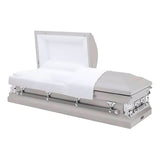




Nobody shops for a casket the way they shop for a mattress. You’re doing it on about 48 hours’ notice, in a room with soft lighting, across a desk from someone who does this every week while you’ve never done it once. Which is exactly why the bad information around buying online has survived this long. Almost nobody is in a position to check it.
So here’s what’s actually true, what the federal rule actually says, and the one risk in this that’s real.
Myth 1: You have to buy the casket from the funeral home
You don’t, and you haven’t since 1984. That’s when the FTC’s Funeral Rule took effect, and it’s the piece of law doing most of the work in this article.
The rule limits what a funeral home can charge you to three things: a non-declinable basic services fee, the goods and services you actually select, and cash advance items like the death certificate or the organist. A fee for accepting a casket you bought elsewhere isn’t on that list, so it isn’t allowed. The FTC’s compliance guide says it flatly: “you cannot charge an additional fee or surcharge to consumers who purchase a casket elsewhere.”
Two more rights get less airtime. The funeral home can’t require you to be there when the casket is delivered, which matters more than it sounds when the delivery window is Tuesday between 9 and 4 and you’re trying to write a eulogy. And they have to hand you a written casket price list before they show you a single casket.
Remember, showrooms rarely display the cheapest models. Just how ethical or unethical that is, we will not be commenting on that. But it’s certainly something you should keep in mind. Putting profits before service, especially when it’s easy to do so (emotionally distraught state makes for a very exploitable situation), is a habit businesses haven’t invented recently. As a consumer, it’s not only important to know your rights but being street smart too.
Myth 2: Online caskets are cheap and flimsy
A casket is a manufactured box, and the specs are boring and public. Steel caskets come in 20, 18, and 16 gauge, and the number runs backwards: 16-gauge steel is thicker than 20-gauge. Online listings usually print the gauge on the product page. Showroom price cards often don’t, and nothing requires them to.
Now, the part that gets sold as quality. The premium tier in most showrooms is the sealer, or gasketed, casket, with a rubber seal and a crank that locks it down. That’s the feature carrying the jump from one price band to the next.
Except the Funeral Rule forbids a funeral provider from telling you funeral goods will “delay the natural decomposition of human remains for a long term or an indefinite time,” or from claiming protective features a product doesn’t have. So the upgrade justifying the price increase is one the seller is legally barred from describing the way you’re probably picturing it.
That isn’t a knock on funeral homes. It’s a reason the quality question deserves an actual answer instead of a feeling about it. Judge the box on gauge, on wood species and joinery, on the warranty, and on who manufactured it. Every one of those survives being asked over email.
Myth 3: Buying a casket online is unsafe
Here’s where most versions of this article get lazy, so I’ll say the true part out loud: the Funeral Rule does not cover the online retailer.
The rule binds funeral providers, meaning businesses selling both funeral goods and funeral services. A company that sells only caskets isn’t one. No price list requirement, no Funeral Rule recourse, none of it.
What does cover them is the FTC’s Mail, Internet, or Telephone Order Merchandise Rule. A seller needs a reasonable basis to ship within the time it advertised, or within 30 days if it advertised nothing. If it can’t, it has to get your consent to the delay or refund you. Pay by credit card and you’ve got chargeback rights stacked on top.
But fraud was never the real risk here. The calendar is.
The service is Saturday. The casket ships Thursday. Nobody in that sentence has any slack. Before you pay, get three things in writing: the delivery date, who at the funeral home signs for it and during which hours, and what the retailer does if it arrives damaged. That last one matters because damage in transit is your claim against the retailer, not the funeral home’s problem to solve. A funeral director standing in a receiving bay at 7 a.m. on the day of the service has no authority to fix it and no spare casket in your size.
Retailers who do this well quote a firm date and ship overnight. Ask for the date. If what comes back is a range, that’s your answer. Online casket sellers, like Overnightcaskets often have customer reviews and ratings available. This is super important to check first. There’s no claiming, universally, that all online casket buying experiences are absolutely safe. There are indeed some bad apples.

Myth 4: Online caskets end up costing more
The best way to get to the bottom of this is to run some numbers. So that’s exactly what we’ll do without wasting any time.
NFDA’s 2023 General Price List Study puts the median funeral with viewing and burial at $8,300, a figure that already includes a metal casket, and the median metal casket itself at $2,500. Online, an 18-gauge steel casket from a retailer like Titan Casket runs $1,599 with free shipping, and their entry steel line starts at $1,399.
So $2,500 minus $1,599 is $901. Against an $8,300 funeral, that’s just under 11% off the whole bill from a single decision made on a laptop, with nothing else about the service changed. No shorter viewing. No cheaper flowers. No conversation with your family about what’s appropriate.
The gap isn’t magic, either. An online seller runs a warehouse and a website. A funeral home runs a showroom, a chapel, a vehicle fleet, and licensed staff who answer the phone at 3 a.m., and the casket line has historically been where a good share of that gets recovered.
Which is why the third option deserves naming: take the online price to the funeral director and ask what they can do. Plenty will match it or close most of the gap, because a thin margin on a casket already sitting in the building beats no casket sale at all.
Put very simply, asking costs you nothing at all but not looking up the price costs you the leverage.
Myth 5: A funeral home can refuse to use a casket you bought
Legally, no. In the room, sometimes, sort of.
Technically, refusing is a Funeral Rule violation, and the exposure is real: the FTC’s January 2024 announcement cited penalties of up to $51,744 per violation, a figure the agency adjusts for inflation. But a rule is only worth its enforcement, and enforcement here is thin. In 2023 the FTC ran its first undercover phone sweep of the industry. It called more than 250 funeral homes and sent warning letters to 39 of them, after 38 calls turned up homes that either wouldn’t answer pricing questions at all or quoted different prices for identical services.
So the pressure you might feel isn’t imaginary. It just rarely shows up as a refusal. It shows up as a delay, a raised eyebrow, a warning about whether the box will fit, a remark about what the family will think. All the various ways for business owners and sellers to get the better of you. And nobody will blame you if you fall for a tactic like this at a time like this.
There’s one wrinkle worth mentioning though. The Institute for Justice counts three states, Oklahoma, Virginia, and South Carolina, that still require a funeral director’s license to sell caskets, and it filed a fresh challenge to Oklahoma’s version in February 2026. Louisiana had one of these laws until a group of Benedictine monks got it struck down in federal court in 2013. Those statutes restrict who may sell a casket inside the state. They don’t restrict what you may buy or where you may buy it, and they don’t touch a funeral home’s obligation to accept it. Just something to keep in mind before you buy if you’re in one of these three states.
If you do get pushback, name the thing. Say Funeral Rule, say 16 CFR Part 453, ask for the refusal in writing. Most of the time the conversation ends right there, because the person across the desk knows exactly what that is. When it doesn’t end there, file at reportfraud.ftc.gov.
And a funeral director who wants to argue about where the casket came from has just told you something useful about the rest of the bill. Listen to it.